
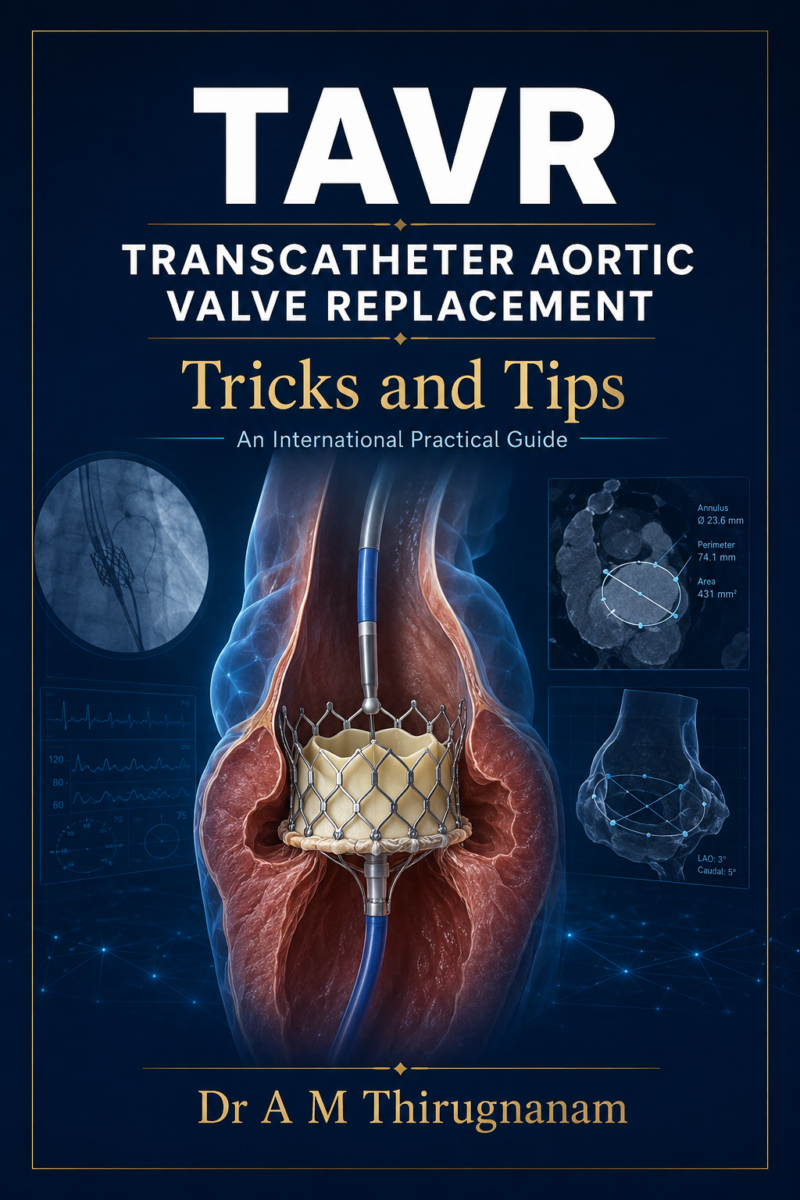
Why I wrote this book
The PARTNER and Evolut programmes took TAVR from inoperable patients to low-risk ones, and with that expansion the margin for avoidable error has shrunk. Younger patients will live with our valve, our commissural alignment and our pacemaker rate for decades, and many will need coronary access or a second valve later.
The difference between a routine case and a difficult one is usually decided at planning, in the details operators pass on to each other informally. I wrote this book to put those details down in one place.
What the guide covers
Before the case: patient selection, CT-based annular sizing, coronary height and sinus assessment, access planning and device selection.
During the case: vascular access, implantation technique, commissural alignment, coronary protection, and haemodynamic assessment of the result.
Difficult anatomy: bicuspid valves, heavily calcified or small annuli, low coronary heights, horizontal aortas, valve-in-valve procedures and hostile iliofemoral access.
When things go wrong: paravalvular regurgitation, conduction disturbance, coronary obstruction, annular rupture, vascular injury, embolic risk, malposition and emergency bailout techniques.
Who I had in mind
Interventional cardiologists and structural heart specialists starting or growing a TAVR programme, cardiac surgeons and imaging specialists on the heart team, cath-lab staff, and fellows preparing for structural training.
The book at a glance
| Author | Dr A M Thirugnanam, MD, MSICP, FSCAI, Ph.D., Senior Interventional Cardiologist |
|---|---|
| Focus | Planning, implantation technique, complex anatomy, complications and bailout |
| Audience | Structural heart operators and heart teams worldwide |
| Format | eBook, delivered by CardiologyBooks.com |
Questions readers ask me
Is the book device-specific?
No. It focuses on principles that apply across balloon-expandable and self-expanding platforms, and discusses device selection as part of planning.
Does it cover bicuspid and valve-in-valve TAVR?
Yes, both are covered within the section on challenging anatomy.
Will it help with complication management?
A dedicated section covers recognition, prevention and bailout for the major TAVR complications.
Discover more from Dr AM Thirugnanam
Subscribe to get the latest posts sent to your email.



Reviews
There are no reviews yet.