
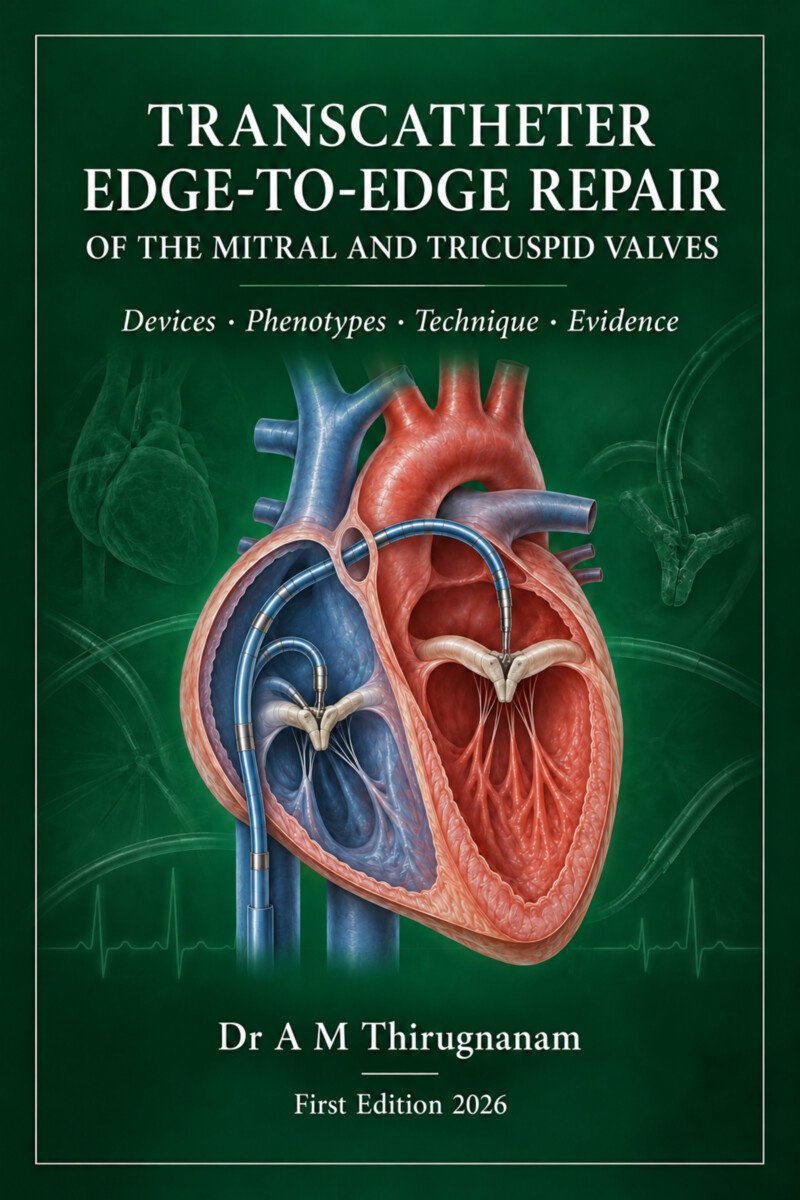
Why I wrote this book
Edge-to-edge repair is deceptively simple to describe and genuinely hard to do well. In my experience the cases that go wrong rarely fail because of the clip itself; they fail earlier, at the point where the anatomy was misread, the regurgitant mechanism was misclassified or the team accepted a grasp that looked adequate on one view and was not.
The trial history makes the same point. EVEREST II, COAPT and MITRA-FR, and later TRILUMINATE on the tricuspid side, taught us that phenotype and patient selection decide outcomes as much as technique does. I wanted a single book that carries that lesson all the way from the screening echo to the moment of final release.
How the book is organised
I built it around the decisions an operator actually faces, in the order they arrive:
- Is this valve suitable? Degenerative versus functional mitral regurgitation, primary versus secondary tricuspid regurgitation, and how to phenotype each one.
- Is this patient suitable? Heart-team assessment and multimodality imaging before anyone opens a groin.
- Getting there. Transseptal puncture height and position, access and device choice.
- Doing it. Steering, alignment, leaflet grasping and insertion, using TEE and fluoroscopy together rather than in turn.
- Knowing when to stop. Residual regurgitation weighed against the transmitral or transtricuspid gradient, and recognising single-leaflet device attachment or inadequate capture before release.
- When it is difficult. Challenging anatomies, intraprocedural troubleshooting, complication prevention and management, then follow-up and where the field is heading.
Who I had in mind
Interventional cardiologists and structural heart specialists building or refining a TEER practice; the echocardiographers and anaesthesiologists who share the procedure with them; cardiothoracic surgeons sitting on the heart team; and fellows who want to understand why experienced operators make the choices they do.
The book at a glance
| Author | Dr A M Thirugnanam, MD, MSICP, FSCAI, Ph.D., Senior Interventional Cardiologist |
|---|---|
| Length | 460 pages |
| Scope | Mitral and tricuspid TEER: anatomy, phenotypes, imaging, technique, evidence |
| Format | PDF eBook, instant download from this site after PayPal checkout |
| Edition | First Edition, 2026 |
Questions readers ask me
Does the book cover tricuspid as well as mitral repair?
Yes. Primary and secondary tricuspid regurgitation, tricuspid phenotyping and transtricuspid gradient assessment are treated alongside the mitral material rather than as an appendix.
Is it tied to one device?
No. The emphasis is on anatomy, imaging and decision-making that apply across edge-to-edge systems, with device selection discussed as a planning decision.
I am a fellow — is it too advanced?
It is written for operators, but the early chapters on mechanism, phenotype and patient selection are exactly where a fellow should start.
Discover more from Dr AM Thirugnanam
Subscribe to get the latest posts sent to your email.

Reviews
There are no reviews yet.