
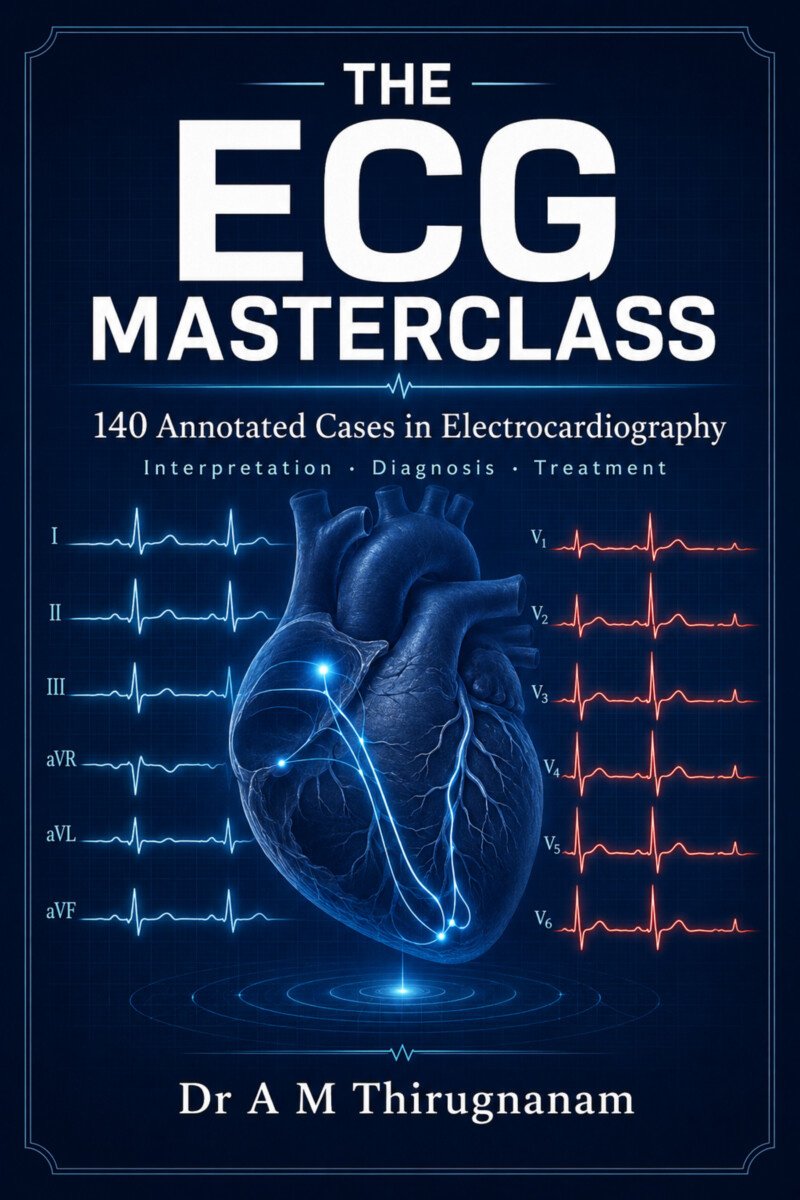
Why I wrote this book
Most people do not struggle with ECG theory. They struggle when a tracing is handed to them at 2 a.m. and they have to decide, in a minute, whether it changes what happens next. Theory chapters do not rehearse that moment; cases do.
So this book is almost entirely cases. Each one is annotated the way I would mark it up for a resident standing next to me: what you see first, what you should look for next, what else it could be, and what you would actually do.
What each case trains you to do
- Read systematically — rate, rhythm, axis and intervals before you let a striking ST segment hijack your attention.
- Look at the components — P waves, QRS morphology and ST–T changes, each examined deliberately.
- Reason to a diagnosis — with the differentials that matter listed beside it.
- Act on it — the management principle that follows from the finding.
Across the 140 cases you will meet tachy- and bradyarrhythmias, conduction disease and heart block, ischaemia and infarction patterns, chamber enlargement and hypertrophy, electrolyte and drug effects, pre-excitation and paced rhythms, and the high-risk tracings that must never be filed without action.
Who I had in mind
Cardiology fellows and medical residents; emergency, critical-care and internal-medicine physicians; general practitioners who read their own ECGs; nurses in coronary and intensive care; and candidates revising for cardiology or medicine examinations who need volume and variety rather than another rulebook.
The book at a glance
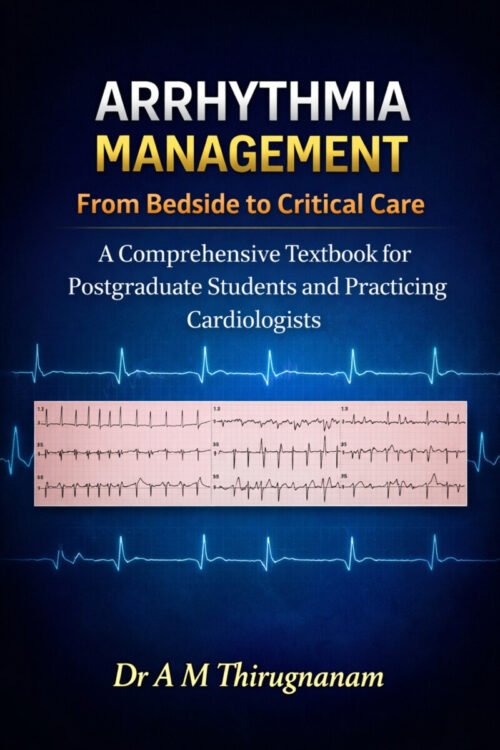
| Author | Dr A M Thirugnanam, MD, MSICP, FSCAI, Ph.D., Senior Interventional Cardiologist |
|---|---|
| Length | 340 pages |
| Cases | 140 annotated ECGs with interpretation, diagnosis and treatment |
| Format | PDF eBook, instant download from this site after PayPal checkout |
| Best used for | Daily practice, case-based revision, board preparation |
Questions readers ask me
How is this different from your ECG Quick Notes?
Quick Notes is a structured reference organised by topic. The Masterclass is a case book: you practise on tracings and learn the reasoning. Many readers use the two together.
Is it suitable for beginners?
Yes, if you already know the basic waves and intervals. The systematic approach in every case reinforces good habits from the start.
Does it include management, not just diagnosis?
Yes. Every case closes with the treatment or next-step principle that the finding implies.
Discover more from Dr AM Thirugnanam
Subscribe to get the latest posts sent to your email.

Reviews
There are no reviews yet.