


Background
Severe symptomatic aortic stenosis carries a poor prognosis. Until relatively recently, surgical aortic valve replacement has been the standard of care in adults with severe symptomatic aortic stenosis. However, the risks associated with surgical aortic valve replacement are increased in elderly patients and those with concomitant severe systolic heart failure or coronary artery disease, as well as in patients with comorbidities such as cerebrovascular and peripheral arterial disease, chronic kidney disease, and chronic respiratory dysfunction.
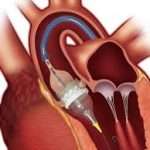
Transcatheter aortic valve replacement (TAVR) was developed as an alternative to the surgical approach in this high-risk and inoperable population. TAVR is a minimally invasive, catheter-based procedure to replace the function of the aortic valve. Indicated for patients at intermediate or greater risk for open heart surgery, TAVR may be an excellent option for certain patients because the prevalence of aortic stenosis and comorbidities may increase the risks associated with surgical aortic valve replacement (SAVR). The entire procedure typically takes approximately 1-2 hours. A heart team comprising cardiac surgeons, interventional cardiologists, and other aortic stenosis experts may determine what the best procedure is as well as take into account other considerations such as whether the patient should receive a mild sedative or general anesthesia.
At the start of the procedure, surgeons make a small incision in one of three places, the groin, the neck, or an intercostal space. A thin, flexible catheter with the heart valve is guided through the incision into the artery and to the diseased valve. The TAVR heart valve is placed in the diseased or failing surgical valve; it begins working immediately. The catheter is then removed and the incision closed.
Currently available devices in the United States include the self-expandable Evolut R and Evolut PRO valves, the balloon-expandable Sapien3 and Sapien 3 Ultra valves, and the mechanically-expandable Lotus Edge valve.
Indications
Inclusion criteria
No established indications or guidelines exist yet for transcatheter aortic valve replacement (TAVR) in the United States. In clinical trials, the inclusion criteria were as follows:
- Patients with calcific aortic valve stenosis with the following echocardiographic criteria: mean gradient greater than 40 mm Hg or jet velocity more than 4 m/s and an initial aortic valve area (AVA) below 0.8 cm2 or indexed effective orifice area (EOA) of less than 0.5 cm2/m2; qualifying AVA baseline measurement must be within 45 days of the date of the procedure
- A cardiac interventionalist and two experienced cardiothoracic surgeons agree that medical factors either preclude operation or are high risk for surgical aortic valve replacement (SAVR), based on a conclusion that the probability of death or serious irreversible morbidity exceeds the probability of meaningful improvement; the surgeons’ consult notes shall specify the medical or anatomic factors leading to that conclusion and include a printout of the calculation of the Society of Thoracic Surgeons (STS) score to additionally identify the risks in the patient; at least one of the cardiac surgeon assessors must have physically evaluated the patient
- Patient is deemed to have symptomatic aortic valve stenosis, as differentiated from symptoms related to comorbid conditions and as demonstrated by New York Heart Association (NYHA) functional class II or greater
In the European Union, TAVR is commercially available, and the procedure is performed in patients with severe aortic stenosis who are high-risk surgical candidates with a logistic EuroScore of more than 20% and in patients who have a contraindication to SAVR.
Contraindications
Contraindications to transcatheter aortic valve replacement (TAVR) and exclusion criteria are as follows:
- Evidence of an acute myocardial infarction (MI) at 1 month (30 days) or less before the intended treatment (defined as Q-wave MI, or non–Q-wave MI with total creatine kinase [CK] elevation of CK-MB [muscle/brain] twice the normal level in the presence of MB elevation and/or troponin level elevation [World Health Organization definition])
- Aortic valve is a congenital unicuspid or congenital bicuspid valve or is noncalcified
- Mixed aortic valve disease (aortic stenosis and aortic regurgitation with predominant aortic regurgitation >3+)
- Hemodynamic or respiratory instability requiring inotropic support, mechanical ventilation, or mechanical heart assistance within 30 days of the screening evaluation
- Need for emergency surgery for any reason
- Hypertrophic cardiomyopathy with or without obstruction
- Severe left ventricular (LV) dysfunction with an LV ejection fraction (LVEF) of less than 20%
- Severe pulmonary hypertension and right ventricular (RV) dysfunction
- Echocardiographic evidence of intracardiac mass, thrombus, or vegetation
- A known contraindication or hypersensitivity to all anticoagulation regimens or an inability to undergo anticoagulation for the study procedure
- Native aortic annulus smaller than 18 mm or larger than 25 mm as measured with echocardiography
- Magnetic resonance imaging (MRI)-confirmed stroke or transient ischemic attack (TIA) within 6 months (180 days) of the procedure
- Renal insufficiency (creatinine level >3 mg/dL) and/or end-stage renal disease requiring chronic dialysis at the time of screening
- Estimated life expectancy of less than 12 months (365 days) owing to noncardiac comorbid conditions
- Severe incapacitating dementia
- Significant aortic disease, including abdominal aortic or thoracic aneurysm, defined as a maximal luminal diameter of 5 cm or greater, marked tortuosity (hyperacute bend), aortic arch atheroma (especially if thick [>5 mm], protruding, or ulcerated] or narrowing (especially with calcification and surface irregularities) of the abdominal or thoracic aorta, severe “unfolding” and tortuosity of the thoracic aorta
- Severe mitral regurgitation In a retrospective study (2008-2012) that evaluated whether high-risk patients with concomitant severe aortic stenosis and mitral valve disease should undergo double valve surgery (surgical aortic valve replacement and mitral valve surgery), investigators found that long-term survival in these patients may be similar to those for patients undergoing TAVR, but that surgical correction of double valvular disease in this patient population may not have a mortality benefit relative to TAVR alone.
Discover more from Dr AM Thirugnanam
Subscribe to get the latest posts sent to your email.


Appreciate the recommendation. Will try it out.
This is a topic which is near to my heart…
Cheers! Where are your contact details though?
I am curious to find out what blog platform you happen to be working with?
I’m having some minor security issues with my latest website and I’d like
to find something more safeguarded. Do you have any suggestions?
Excellent post. I used to be checking continuously this blog and I
am impressed! Extremely helpful info particularly the final part :
) I handle such information much. I used to be looking for this particular info for a
long time. Thanks and best of luck.
It’s awesome for me to have a web page, which is good for my knowledge.
thanks admin
I was wondering if you ever considered changing the structure of your website?
Its very well written; I love what youve got to say.
But maybe you could a little more in the way of content so
people could connect with it better. Youve got an awful
lot of text for only having 1 or two pictures. Maybe you could space it out better?
Ahaa, its nice dialogue concerning this piece of writing here at this website, I have
read all that, so at this time me also commenting here.
I was wondering if you ever thought of changing the structure of your website? Its very well written; I love what youve got to say. But maybe you could a little more in the way of content so people could connect with it better. Youve got an awful lot of text for only having 1 or 2 pictures. Maybe you could space it out better?
I am lucky that I discovered this web site, just the right information that I was searching for! .
I am not very fantastic with English but I line up this real easy to understand.
What’s Taking place i am new to this, I stumbled upon this I have found It positively useful and it has
helped me out loads. I hope to contribute & aid other customers like its helped me.
Good job.
You are my intake, I possess few web logs and sometimes run out from to post .
Hello! This is my 1st comment here so I just wanted to give a quick shout out and say I genuinely enjoy reading through your articles. Can you suggest any other blogs/websites/forums that cover the same topics? Thanks!
Some truly rattling work on behalf of the owner of this internet site, dead great content material.
I like this website very much so much great info .
After talking about this with my brother who was all for the covid vaccine who recently had a case of blood clots, I would strongly reccommend having a d-dimer test. As far as I am concerned, the people who got jabbed were fooled. If like many people you now have jab remorse I would definately take a look into vaccinedetox.co. I witnessed excellent progress so far!!
Lovely just what I was searching for.
Thanks for the marvelous posting! I certainly enjoyed reading it, you
can be a great author. I will be sure to bookmark your blog
and will eventually come back in the foreseeable future.
I want to encourage continue your great writing, have
a nice holiday weekend!
Today, I went to the beach front with my children. I found a sea shell and gave it to my 4 year old daughter and said “You can hear the ocean if you put this to your ear.” She placed the shell to her ear and screamed. There was a hermit crab inside and it pinched her ear. She never wants to go back! LoL I know this is totally off topic but I had to tell someone!
There’s noticeably a bundle to find out about this. I assume you made sure good points in features also.
Pеculiar article, totally what I needed.
Some truly great information, Gladiolus I noticed this.
Thank you for sharing excellent informations. Your web-site is very cool. I’m impressed by the details that you’ve on this site. It reveals how nicely you understand this subject. Bookmarked this web page, will come back for more articles. You, my pal, ROCK! I found just the info I already searched all over the place and just couldn’t come across. What an ideal web site.
Greate article. Keep writing such kind of info on your site.
Im really impressed by it.
Hello there, You have performed an incredible job.
I’ll definitely digg it and in my opinion recommend to my friends.
I am confident they will be benefited from this website.
Thank you very much for sharing, I learned a lot from your article. Very cool. Thanks. nimabi
I am sure there are many more pleasant instances up front
Perfectly indited content material , thankyou for information.
Thanks for the good writeup. It in fact was a leisure account it. Look advanced to more brought agreeable from you! By the way, how could we be in contact?
you can contact through our email dramthirugnanam05@gmail.com
Can you be more specific about the content of your article? After reading it, I still have some doubts. Hope you can help me.
Thank you for your sharing. I am worried that I lack creative ideas. It is your article that makes me full of hope. Thank you. But, I have a question, can you help me?