
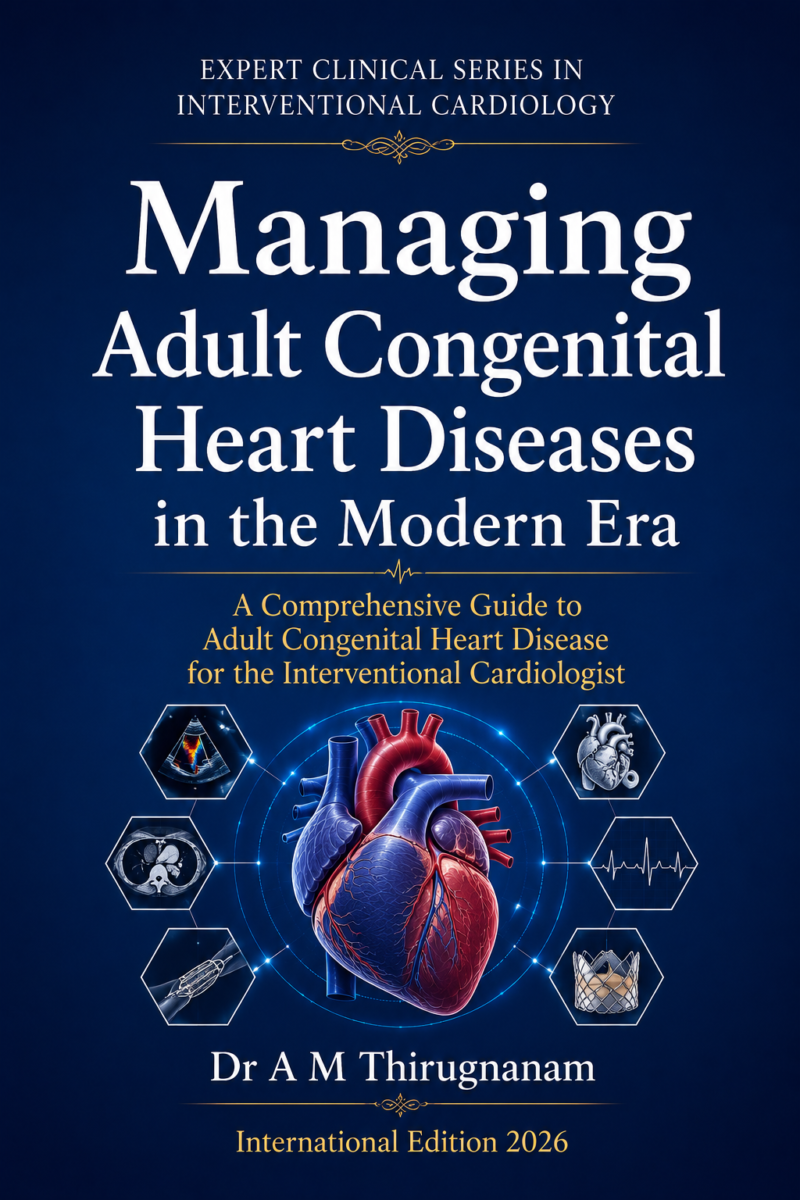
Adult congenital heart disease is no longer a rare chapter hidden at the end of cardiology textbooks. It has become one of the fastest-growing and most demanding frontiers in modern cardiovascular medicine. Advances in pediatric cardiac surgery, imaging, intensive care, catheter-based intervention, and long-term surveillance have allowed thousands of children born with congenital heart disease to survive into adulthood. Today, these patients present not only with repaired lesions, but also with residual shunts, valvular abnormalities, pulmonary hypertension, arrhythmias, ventricular dysfunction, cyanosis, pregnancy-related risks, and complex reintervention needs.
Managing ACHD in the Modern Era is written as a focused, practical, and clinically relevant guide for the interventional cardiologist who encounters adult congenital heart disease in the catheterization laboratory, outpatient clinic, emergency setting, or multidisciplinary heart team discussion. The book bridges the gap between classical congenital cardiology and contemporary interventional practice, offering a clear approach to anatomy, physiology, diagnosis, imaging, hemodynamic assessment, procedural decision-making, and long-term follow-up.
Adult congenital heart disease requires a different mindset. The operator must think beyond a single stenosis, a single valve, or a single chamber. Every lesion carries a history: the original anatomy, childhood repair, residual defect, surgical patch, conduit, baffle, collateral circulation, ventricular adaptation, pulmonary vascular response, and future risk. A successful intervention depends not only on technical skill, but also on understanding the patient’s entire cardiovascular journey.
This book covers essential ACHD conditions including atrial septal defect, ventricular septal defect, patent ductus arteriosus, coarctation of the aorta, pulmonary valve disease, tetralogy of Fallot, transposition physiology, Fontan circulation, Ebstein anomaly, systemic right ventricle, bicuspid aortic valve disease, Eisenmenger physiology, and complex postoperative anatomy. Special emphasis is placed on catheter-based therapies such as device closure, balloon dilatation, stenting, pulmonary valve implantation, management of conduits, hybrid strategies, and intervention in high-risk or anatomically challenging cases.
The modern ACHD specialist must also be fluent in multimodality imaging. Echocardiography, CT angiography, cardiac MRI, fluoroscopy, angiography, and 3D reconstruction now work together to guide safe and precise intervention. This book highlights how imaging, hemodynamics, and clinical judgment should be integrated before every procedure.
Equally important are the nonprocedural dimensions of ACHD care. Pregnancy counseling, infective endocarditis prevention, anticoagulation, arrhythmia surveillance, heart failure management, pulmonary hypertension therapy, exercise advice, transition of care, psychosocial support, and lifelong follow-up are vital parts of treatment. The interventional cardiologist must recognize when to intervene, when to observe, when to refer for surgery, and when a multidisciplinary ACHD center is essential.
This Kindle edition has been designed for rapid reading, bedside reference, clinical revision, and practical application. It is suitable for cardiologists, interventional cardiologists, congenital heart disease fellows, cardiac surgeons, pediatric cardiologists involved in transition care, intensivists, postgraduate trainees, nurses, technicians, and all professionals caring for adults with congenital heart disease.
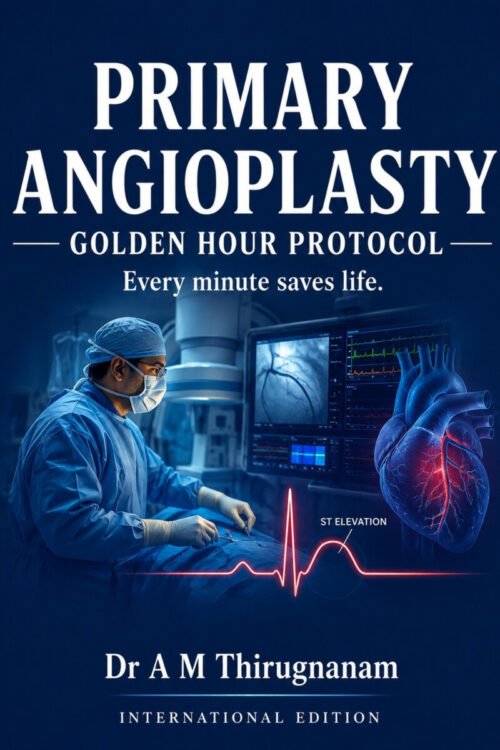
Written by Dr A M Thirugnanam, Senior Interventional Cardiologist, this book reflects a modern, procedure-oriented, patient-centered approach to ACHD care. It aims to simplify complexity without losing clinical depth. Each topic is presented with clarity, relevance, and practical value so that the reader can move confidently from diagnosis to decision-making and from planning to safe intervention.
Managing ACHD in the Modern Era is more than a textbook title. It is a clinical invitation to understand a unique population of patients whose lives have been extended by medicine, but whose care now demands expertise, precision, compassion, and lifelong commitment. For the modern interventional cardiologist, ACHD is not an occasional challenge—it is an essential field of mastery.
Related
Discover more from Dr AM Thirugnanam
Subscribe to get the latest posts sent to your email.

Reviews
There are no reviews yet.